[writing]
Agentic AI in Healthcare: From Monitoring to Meaningful Action
Turning continuous patient monitoring into safe, timely action with agentic AI.
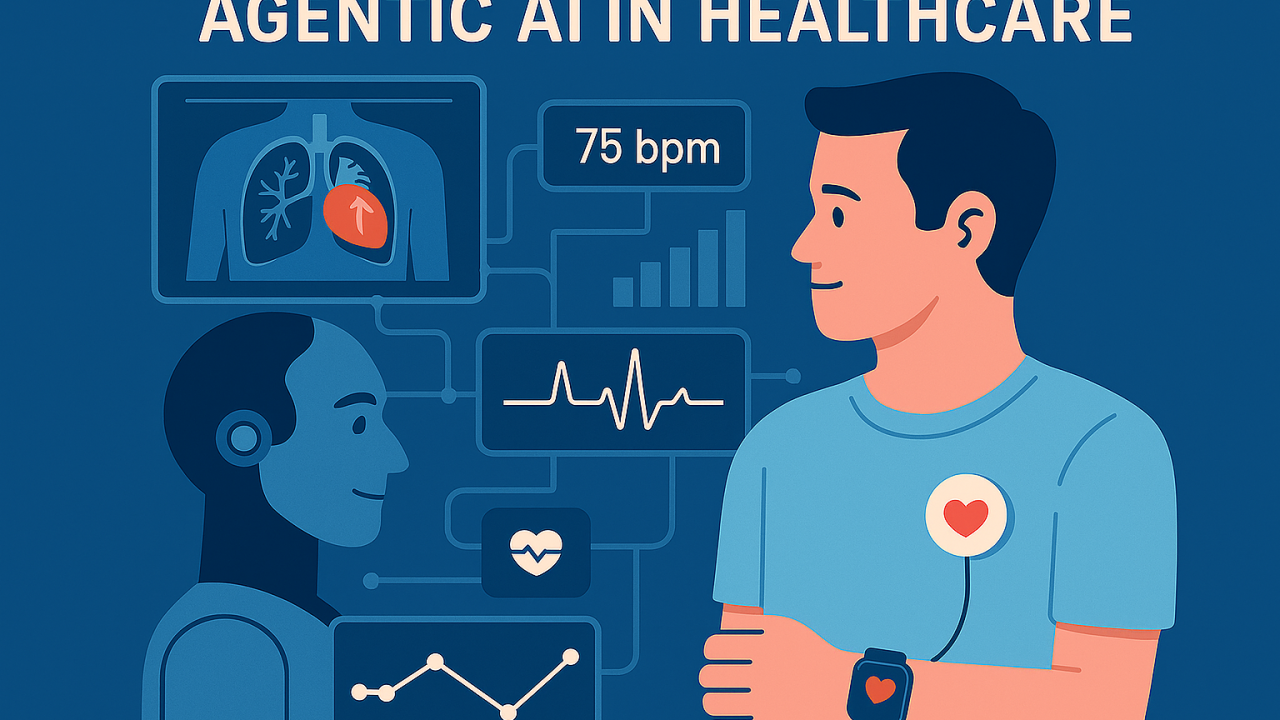
Clinicians and patients are awash in data—from continuous heart monitors and wearables to lab results and imaging. Yet the value of that data is only realized when the right insight reaches the right person at the right time. In telemetry units today, signals from continuous cardiac monitors are streamed to the cloud and scanned by technicians. Despite best efforts, human bottlenecks can delay recognition of potentially life‑threatening rhythms or subtle deterioration. Agentic AI—goal‑driven AI systems that can sense, reason, act, and collaborate with care teams—offers a path to faster interventions, more personalized care, and lower cost.
Why the Status Quo Isn’t Enough
-
Alarm fatigue and missed events: The Joint Commission documented big alarm-related adverse events (several deaths) in 2009–2012, and ECRI has repeatedly listed alarm hazards among top health technology risks. High alarm volumes and non-actionable alerts make it harder to catch the true emergencies.
-
Time is clinical currency: In conditions like ventricular tachycardia, complete heart block, or sepsis, minutes matter. Even small delays from manual triage can change outcomes.
-
Rising workload and costs: Health systems face staffing shortages and growing telemetry volumes; manual monitoring doesn’t scale.
What Is Agentic AI? Agentic AI systems:
-
Monitor continuously: Ingest and interpret multimodal data (ECG, SpO2, BP, notes) in real time.
-
Reason with context: Combine vitals with history, meds, and care protocols to assess risk.
-
Act with guardrails: Triage, escalate, and recommend next steps via approved workflows, keeping clinicians in the loop.
-
Learn and adapt: Improve specificity, personalization, and clinician trust through feedback and audit.
How Agentic AI Improves Outcomes and Operations
1. Monitoring and Rapid Response
-
Event detection with fewer false alarms: AI agents filter noise and corroborate signals (e.g., cross-checking ECG, pleth, and movement) before escalating. Studies in alarm management show 40–60% reductions in nonactionable alarms in ICUs after algorithmic and policy improvements, easing alarm fatigue and improving responsiveness.
-
Faster, structured escalation: When sustained VT, high-grade AV block, or a significant ST change is detected, the agent can 1.) Verify signal quality and confirm multi-lead consistency. 2.) Auto-prioritize severity and notify the right on-call role via secure channels. 3.) Present a concise, clinically framed summary (trend strips, vitals trajectory, recent labs, medications) and next-step options aligned to local protocols. 4.) Track acknowledgment and re-escalate if needed.
-
Evidence that earlier action saves lives: Real-world early warning systems show that timely AI-supported alerts can be associated with mortality reductions. For example, a large multi-hospital study of an AI sepsis early warning tool (TREWS) found earlier treatment initiation and an associated relative reduction in mortality when clinicians engaged with the alert promptly (Nature Medicine, 2022).
2. Personalized Treatment Plans
-
Tailored care pathways: Agents synthesize comorbidities, prior responses, and guideline logic to suggest individualized titration, diagnostics, or consults. For cardiac patients, that can mean nuanced beta-blocker adjustments, anticoagulation considerations in new AFib, or expedited echo based on dynamic risk.
-
Continuous reassessment: As new data arrives, the agent updates risk and recommendations, closing the loop between monitoring and management.
-
Population impact: Remote patient monitoring programs have shown meaningful benefits at scale. The US Veterans Health Administration’s Home Telehealth program reported a 19% reduction in hospital admissions and a 25% reduction in bed days among enrolled patients—illustrating how continuous oversight and timely intervention can reduce acute events.
3. Lower Total Cost of Care
-
Fewer avoidable escalations: Earlier detection and tailored interventions reduce code events, ICU transfers, and readmissions—major cost drivers.
-
Productivity gains: Automating triage, summarization, and protocol matching frees technicians and nurses for higher-value care. Industry analyses estimate AI could unlock tens to hundreds of billions of dollars in annual value in US healthcare through efficiency and quality gains; McKinsey has projected up to $360B per year as capabilities mature.
-
Right-sizing monitoring: Agents can identify stable patients and safely decrease monitoring intensity, saving consumables and staff time without compromising safety.
A Day-in-the-Life: Continuous Heart Monitoring with an Agent
-
00:00: An inpatient’s telemetry shows intermittent nonsustained VT. The agent confirms lead integrity, corroborates with pleth, and notes recent potassium of 3.2 mmol/L and a missed dose of beta-blocker.
-
00:01: Risk stratified as “urgent.” The agent pages the telemetry nurse and on-call hospitalist with a one-screen summary and recommended actions per local policy (recheck K+, replace potassium, consider magnesium, resume/titrate beta-blocker, obtain 12‑lead ECG).
-
00:03: Nurse acknowledges and accepts potassium replacement order set (provider cosign required). The agent sets a 30-minute re-check for rhythm and electrolytes.
-
00:35: VT resolves after correction; event, actions, and outcomes are auto-documented for quality review.
Safety, Equity, and Compliance by Design
-
Human-in-the-loop: Alerts and orders follow clearly defined approval pathways; clinicians retain authority.
-
Guardrails and auditability: Versioned models, explainable rationales, and full audit trails support safety and regulatory needs.
-
Bias mitigation: Continuous monitoring for performance across demographics and comorbidities; retraining and thresholds adjusted to ensure equitable care.
-
Privacy and security: HIPAA-compliant architecture, least-privilege access, encryption, and secure messaging; adherence to IEC 62304 and ISO 14971 for software lifecycle and risk management. Pursue FDA pathways as clinical functionality warrants.
Measuring What Matters
-
Time from event onset to clinician acknowledgment
-
Time from alert to intervention
-
Nonactionable alarm rate and alarm-to-action ratio
-
Unplanned ICU transfers, rapid response calls, and code blue rates
-
30-day readmissions and length of stay
-
Cost per monitored patient and staff productivity
-
Clinician satisfaction and patient experience
Getting Started: An Implementation Blueprint
-
Start with a high-impact use case (e.g., cardiac telemetry). Map current workflows and escalation paths.
-
Integrate data sources: Telemetry waveforms, EHR vitals/labs/meds, staffing rosters, secure messaging.
-
Co-design protocols with clinical leaders; encode local policies.
-
Pilot with clear KPIs, safety triggers, and a feedback loop; run A/B periods to quantify impact.
-
Scale thoughtfully: Expand to other units and conditions (heart failure, COPD, post-op monitoring, sepsis early warning), maintaining governance and model oversight.
The Bottom Line Agentic AI turns monitoring into meaningful, timely action. By filtering noise, surfacing context, and orchestrating the next best step—always with clinician oversight—health systems can reduce adverse events, deliver more personalized care, and lower operating costs.
Emachinelabs is building Agentic AI solutions for healthcare domain that make this future practical, safe, and scalable. To learn more or pilot with us, please contact us.