[writing]
AI Agents vs. Agentic AI vs. MCP Server–Based AI vs. A2A AI: Business Angle
Four overloaded terms untangled for decision makers: AI agents, agentic AI, MCP-based AI, and A2A.
Summary
If you’ve sat through a few “agent” demos lately, you’ve probably heard four terms thrown around as if they mean the same thing: AI Agent, Agentic AI, MCP server–based AI, and A2A AI. They don’t. Here’s a clean way to think about them—and how to put them to work without tripping over hype.
This article clarifies four terms and then shows where each fits, how they differ, and when to use which. I will be publishing two versions of the explanations, this article covers business friendly version.
Part 1 — Business Version
Quick mental model
-
AI Agent is the doer, a software helper that can decide and act on goals (the digital teammate that takes steps and uses tools).
-
Agentic AI is the work-style, making today’s AI models behave like real assistant (planning, using tools, remembering, self-correcting).
-
MCP servers are the door keys and turnstiles (connect AI safely to your company’s systems using a safe, standardized, auditable connector layer).
-
A2A (Agent-to-Agent) is the meeting room (agents coordinating with other agents to negotiate, collaborate, or transact, sometimes across companies).
Plain-English definitions
-
AI Agent: A goal-driven digital assistant that can take multiple steps, use approved tools/APIs, and bring back a result with varying levels of autonomy and oversight. Think “junior teammate you can supervise.”
-
Agentic AI: The way we make today’s models act like that teammate—planning, using tools, iterating, checking their work and reflecting so they behave more like assistants that can get things done.
-
MCP server–based AI: An enterprise-friendly, standard, auditable way to connect AI to your systems (CRM, ERP, ticketing, data warehouse) with permissions and logs.
-
A2A AI: Agents coordinating with other agents to get a cross-team or cross-company job done end-to-end (request, reply, negotiate, approve).
Where each one is best suited
-
AI Agent: When you want a single digital assistant to complete a complex task end-to-end (e.g., triaging a support ticket, compiling a competitive brief, preparing a meeting with data pulls).
-
Agentic AI: When you need your existing AI capabilities to be more effective—plan better, use tools reliably, self-correct, and handle multi-step work.
-
MCP server–based AI: When you must connect AI to internal systems safely and at scale, with strong controls, audit logs, and a standardized way to add/remove integrations.
-
A2A AI: When workflows span multiple teams or companies and can be automated as a “conversation” among agents (e.g., procurement quoting, price negotiation, supply chain updates).
Concrete examples
- AI Agent
-
Sales ops: Clean leads, enrich from a data vendor, draft outreach, schedule the first call.
-
Support: Triage a ticket, look up known issues, run basic diagnostics, propose fixes.
-
Finance: Reconcile payments and invoices, flag mismatches, draft variance notes.
-
HR: Screen resumes against must-have criteria, schedule interviews, prep scorecards.
-
Marketing: Research competitors, collect examples, draft a brief and a social thread.
-
IT: Read logs, run predefined checks, prepare an escalation with crisp context.
- Agentic AI
-
Reporting: Plan which data to pull, run queries, chart results, check anomalies, revise.
-
Content: Outline → draft → fact-check → tone adjustment → final polish.
-
Coding: Plan a change, run tests/linters, fix failures, produce a PR summary.
-
Research: Draft a research plan, visit sources, cross-verify, synthesize into a brief.
- MCP server–based AI
-
One connector hub: A single, approved place for assistants to reach Salesforce, Jira, Slack, Notion, a read-only warehouse, etc.—with permissions and audit.
-
Regulated work: Read-only access for PII systems; redaction; time-bound permissions.
-
Reuse: The chat assistant, IDE copilot, and voice bot all reuse the same connectors.
- A2A AI
-
Procurement RFQ: Buyer agent requests quotes; supplier agents reply; pricing/legal agents score; buyer agent negotiates within budget; ERP updates the PO.
-
Supply chain: Inventory agent flags low stock; logistics agent finds lanes; warehouse agent schedules receiving; finance agent reserves funds.
-
Customer service concierge: Intake agent triages; billing agent processes refunds; policy agent approves exceptions; shipping agent prints labels.
-
Travel: Employee agent requests trip; policy agent approves; airline/hotel agents quote; itinerary gets booked.
How to choose (quick tests)
-
If there’s a clear outcome and you can supervise it: AI Agent.
-
If your current AI answers questions but can’t follow a plan, act and self correct: Agentic AI.
-
If the assistant needs access to your systems and you care about governance and scale: MCP servers.
-
If the process spans multiple teams or companies and requires negotiation: A2A.
Mini storylines (how they play together)
**- Quarter-end close (Finance) **
-
Agentic AI drafts a reconciliation plan.
-
AI Agent pulls transactions, flags discrepancies, drafts explanations.
-
MCP servers unlock ERP and bank APIs safely.
-
A2A coordinates with a vendor invoicing agent to fix a mismatch.
- E‑commerce returns (Operations/Support)
-
Agentic AI designs a decision tree for returns.
-
AI Agent validates orders, checks warranty, proposes options.
-
MCP servers connect to OMS/WMS/CRM with least-privilege access.
-
A2A negotiates pickup slots with a logistics agent and issues a label.
- Field service dispatch (IT/Facilities)
-
Agentic AI triages an incident and suggests steps.
-
AI Agent books a tech and reserves parts.
-
MCP servers integrate ticketing, inventory, and calendars.
-
A2A loops in a third‑party maintenance agent for after-hours coverage.
What to watch out for
-
Autonomy risk: Add guardrails and approval points for risky actions.
-
Data security: Use governed connectors (MCP) instead of hardwiring API keys into prompts.
-
Reliability: Start small, measure success/interventions, add fallbacks.
-
Compliance: Log prompts, tool calls, data touched; review integrations centrally.
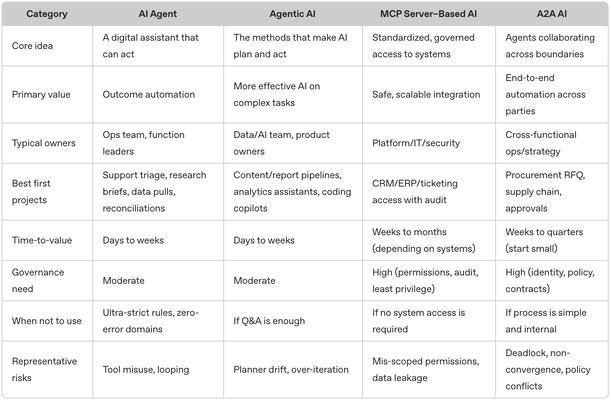
Business comparison table
Final Thoughts
If you’re piloting agents today, pick one valuable, bounded workflow and ship it with guardrails. Use Agentic patterns for reliability, MCP servers for safe access, and only move to A2A once single-agent value is proven. Iterate with metrics, not demos.