[writing]
The Invisible Revolution: How AI is Rewiring the Data Center Network
Why AI traffic broke the old data center network and what is replacing it.
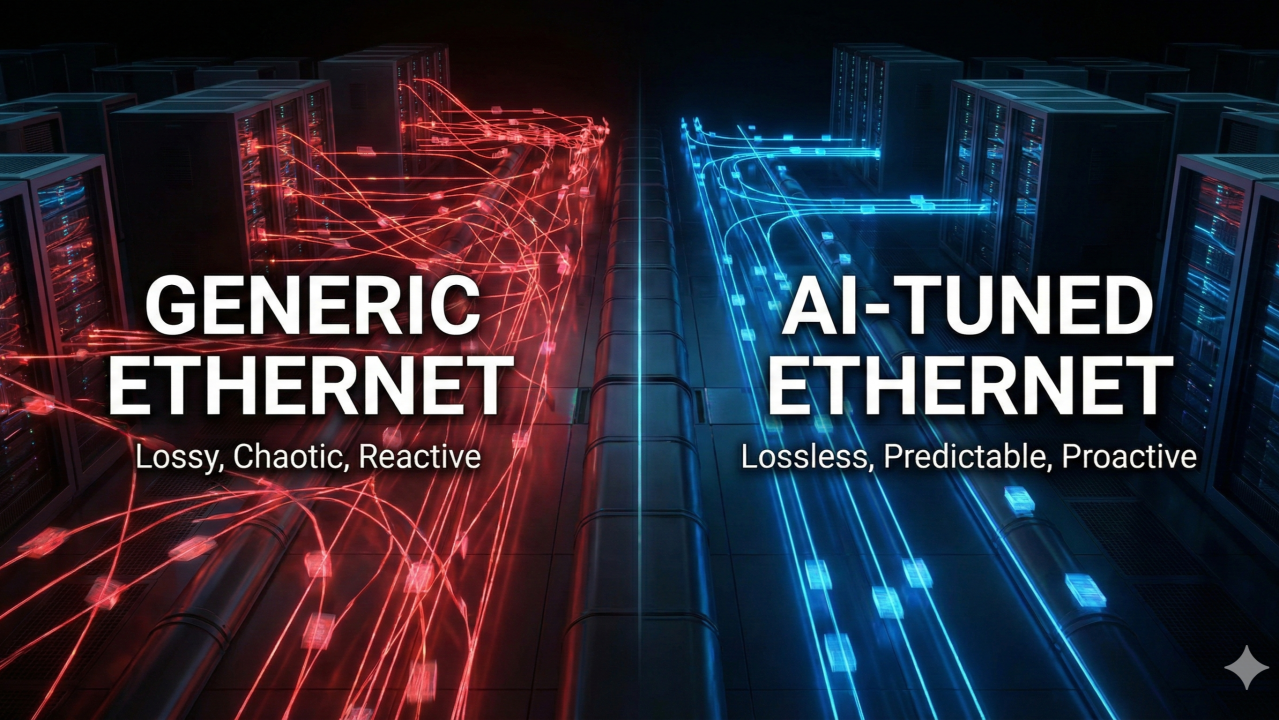
The assumption that “Ethernet is Ethernet” is officially dead.
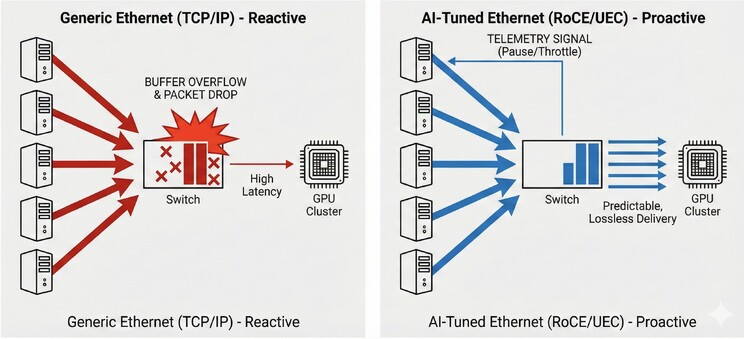
For years, hyperscale networking was dominated by generic Ethernet relying on TCP/IP. It was designed for resilience over unreliable links. If a packet dropped, TCP noticed, waited, and retransmitted. In the world of web applications, this latency was acceptable.
In the world of AI supercomputing, it is catastrophic.
AI training is a massive distributed computing problem. Thousands of GPUs must constantly synchronize vast amounts of data (gradients). If one packet in that synchronization phase is dropped due to switch buffer congestion, the entire cluster—potentially 20,000 GPUs—waits for the retransmission. This “tail latency” event destroys training efficiency.
We are witnessing a fundamental shift from “Generic Ethernet” (best effort, lossy) to “AI-Tuned Ethernet” (predictable, lossless). This shift is being codified by platforms like NVIDIA Spectrum-X and open standards like the Ultra Ethernet Consortium (UEC). They are redefining Ethernet to support RDMA (RoCE v2) at massive scale.
Here is a detailed look at how this new fabric changes critical infrastructure concepts.
1. Redefining the “Transaction” at High Scale
In standard networking, a transaction might be a database query. In AI networking, a transaction is often a “Collective Operation” (like an All-Reduce), where every GPU shares data with every other GPU simultaneously.
This leads to unique traffic patterns that break generic Ethernet:
-
Elephant Flows: Massive, long-lived streams of data, unlike the “mice flows” of web traffic.
-
Incast: The moment when hundreds of senders transmit to a single receiver simultaneously, causing instantaneous buffer overflows in standard switches.
The AI-Tuned Fix: Instead of reactive TCP congestion control (dropping packets when full), AI fabrics are proactive. Through advanced telemetry, the switch communicates directly with the NIC (Network Interface Card) to throttle traffic before congestion occurs, ensuring the “transaction” completes without packet loss.
2. The Evolution of the “Service Mesh” into Hardware
We are used to Service Meshes (like Istio) operating at the software layer to manage traffic between microservices. In AI, the performance demands are too high for software proxies.
The “Service Mesh” is moving down into the hardware, specifically into DPUs (Data Processing Units) and SmartNICs used in Spectrum-X and UEC designs.
-
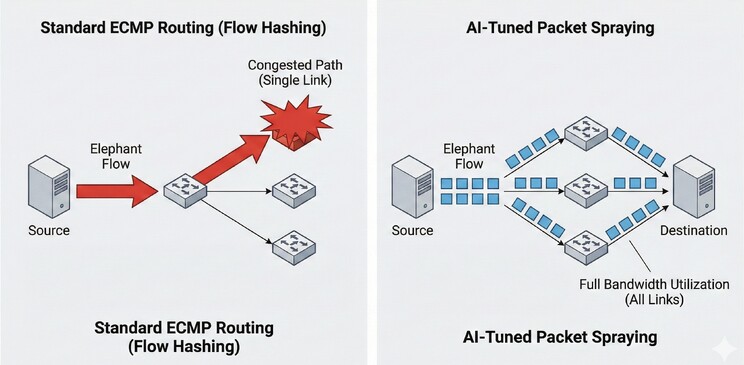
Generic Ethernet: Uses ECMP (Equal-Cost Multi-Path) routing, which hashes a flow to a single path. If two “Elephant Flows” hash to the same path, they collide, causing congestion, while other paths remain idle.
-
AI-Tuned Fabric: Utilizing advanced techniques like Packet Spraying (a key feature of UEC), a single large transaction is split into individual packets and sprayed across all available paths simultaneously, reassembling them at the destination. This ensures 100% utilization of fabric bandwidth and acts as a hardware-based traffic manager.
3. Security in a Direct-Memory-Access World
The magic of modern AI speed is RDMA (Remote Direct Memory Access). It allows one GPU to write data directly into the memory of another GPU across the network, bypassing the remote CPU entirely.
In a multi-tenant cloud, this is terrifying.
If not properly secured, Tenant A could potentially read the memory of Tenant B. Generic Ethernet security (firewalls, IP ACLs) is too slow and CPU-intensive for 800Gbps line rates.
The AI-Tuned Fix: Security is enforced at the NIC hardware level. Modern fabrics implement technologies like Zero Trust RoCE (ZTR). This uses strict memory protection keys and hardware-based encryption (like IPsec or PSP) executed at line rate on the DPU. A tenant can only access memory regions explicitly authorized for their specific job ID. Any unauthorized RDMA attempt is dropped instantly by the hardware, providing isolation without the performance penalty of software checks.
4. Dynamic Configuration via SONiC
In traditional networking, network configurations were relatively static. In an AI cloud, the network topology needs to logically reshape itself constantly.
When a Kubernetes scheduler places a new training job, the network must instantly reconfigure to optimize for that specific workload. A large language model training run has different traffic patterns than an image generation model.
The AI-Tuned Fix: This requirement has solidified SONiC (Software for Open Networking in the Cloud) as the operating system of choice for AI fabrics. SONiC allows the entire network stack to be managed via APIs.
The fabric can dynamically adjust switch buffer allocations, change routing protocols, and push specific congestion control profiles to the NICs based on the job type—all automatically, in seconds.
The Bottom Line
The transition from Generic Ethernet to AI-Tuned Ethernet fabrics like Spectrum-X and UEC is not merely an upgrade in speed; it is a fundamental change in networking philosophy.
We are moving from a world that tolerates loss to one that demands deterministic performance. For organizations investing billions in GPU infrastructure, the network is the critical bottleneck determining whether that investment yields a return in weeks or months.
If you are building for AI, you cannot rely on the networking assumptions of the past two decades.