[writing]
The Hardware-Accelerated Mesh: How DPUs and Ambient Topologies Killed the Data Center Tax
How DPUs and ambient mesh topologies remove the sidecar tax from service networking.
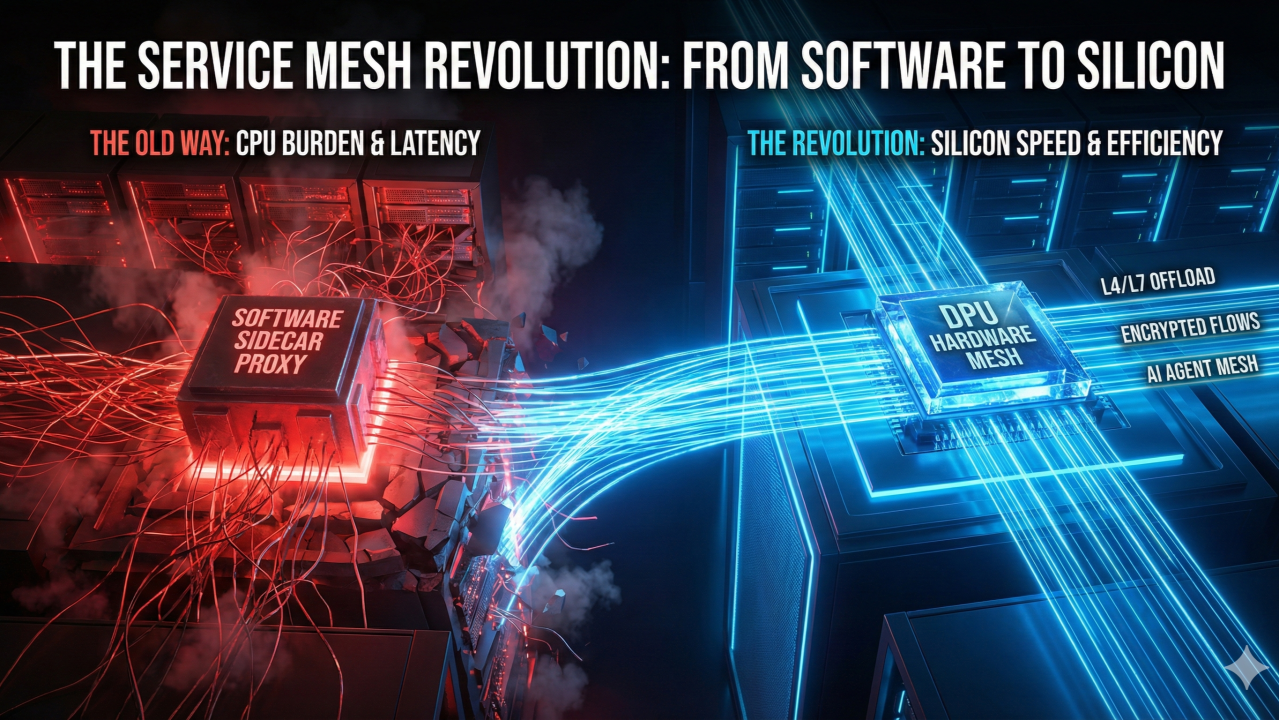
For the last five years, cloud architects have been fighting a losing battle against the Data Center Tax.
As monolithic applications decomposed into thousands of microservices, organizations deployed service meshes (like Istio and Linkerd) to handle mutual TLS (mTLS), L7 routing, and observability. The dominant architecture was the sidecar model: injecting a proxy (typically Envoy) into every single application pod.
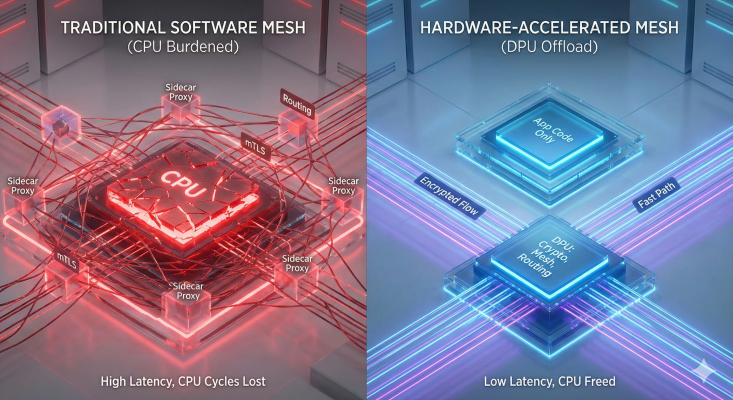
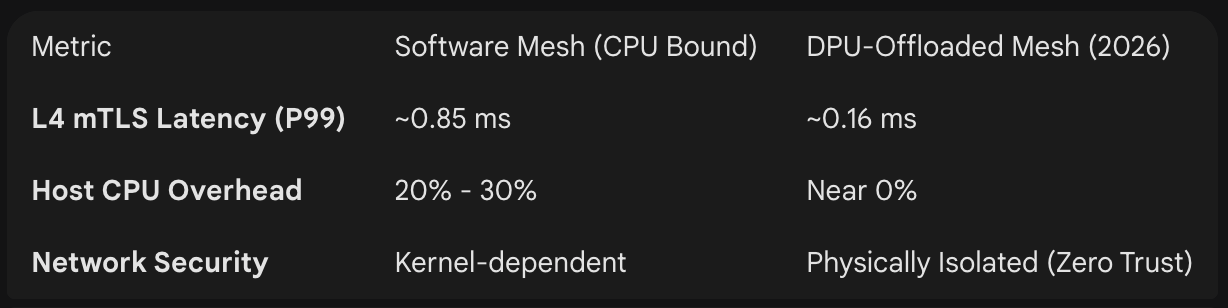
While elegant in theory, the physics of this design are brutal at scale. Traffic originating in user space must traverse the kernels TCP/IP stack to the local Envoy sidecar, get encrypted, traverse the kernel again to the physical network, and repeat the process in reverse on the receiving end. In dense multi-tenant environments, this software proxy layer can consume up to 30% of host CPU cycles—resources that should be generating revenue. Furthermore, this architecture adds approximately 0.63ms to 0.88ms of P99 latency per hop.
In the era of high-frequency trading and Agentic AI workflows—where hundreds of containerized inference microservices must communicate in microseconds—software-bound sidecars are a fatal bottleneck.
In 2026, the solution has arrived through a perfect marriage of software redesign and silicon innovation.
In 2026, the solution has arrived through a perfect marriage of software redesign and silicon innovation.
1. The Software Metamorphosis: Istio Ambient Mesh
You cannot offload a bloated architecture to hardware and expect miracles. The software had to evolve first. This evolution culminated in the General Availability of Istio Ambient Mesh, a sidecarless architecture.
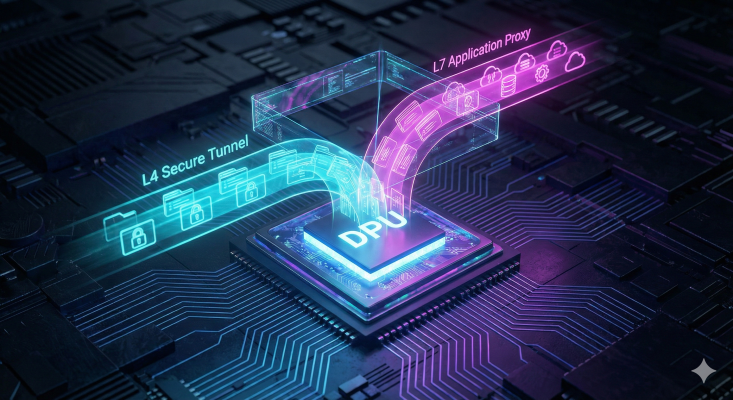
Ambient Mesh solves the proxy bloat by bifurcating the data plane into two distinct layers:
-
The ztunnel (Zero Trust Tunnel): A lightweight, Rust-based DaemonSet deployed once per node. It handles strictly Layer 4 traffic—enforcing mTLS, SPIFFE identity, and TCP authorization.
-
Waypoint Proxies: Dedicated L7 Envoy proxies deployed only when advanced HTTP routing or payload inspection is required, configured on a per-namespace basis.
By removing L7 parsing from the default path, the ztunnel reduces the base mesh latency from ~0.85ms down to a blistering 0.16ms. But the true magic of Ambient Mesh is that its per-node ztunnel architecture maps perfectly to the physical topology of a Data Processing Unit (DPU).
2. Enter the DPU: The Third Pillar of Compute
A DPU or IPU (Infrastructure Processing Unit) is essentially a fully functional mini-server residing on your PCIe bus. They combine high-speed network interfaces (400G/800G) with programmable packet pipelines (like P4) and arrays of embedded ARM cores.
By 2026, the silicon capabilities of these devices have reached staggering levels:
-
NVIDIA BlueField-4: Pushing the boundaries with 800 Gb/s throughput and 64 ARM cores, delivering 6x the compute power of its predecessor.
-
Intel IPU E2200: Featuring 24 Arm Neoverse N2 cores, a 32MB system-level cache, and 400 Gb/s networking.
-
AMD Pensando Salina 400: Utilizing a massive array of 232 proprietary Match Processing Units (MPUs) programmed via P4 to handle stateful connections at 400 Gbps.
3. Offloading the Mesh: Zero Trust at Line Rate
When we combine Ambient Mesh with DPUs, we fundamentally alter the security and performance profile of the data center.
Instead of running the ztunnel as a software process on the host x86 CPU, the ztunnel and its cryptographic keys are deployed directly onto the embedded ARM cores of the DPU.
This achieves true Hardware-Enforced Zero Trust. Because the routing rules, policies, and certificates live on the DPU, the host operating system has zero visibility into the control plane. Even if a tenants container is entirely compromised by a malicious actor, they cannot alter network topologies or extract mTLS keys, because the enforcement mechanism sits on an isolated physical processor.
Furthermore, leveraging native eBPF (Extended Berkeley Packet Filter) frameworks like Cilium, traffic is intercepted at the exact moment the network driver pulls the packet from the NICs receive ring. Utilizing the DPUs inline cryptographic engines (like the BlueFields Public Key Accelerator), asymmetric RSA/ECC handshakes and symmetric AES-GCM encryption are executed at line-rate (400Gbps+) with virtually zero latency penalty.
4. The Economic Reality: Power, TCO, and AI Inference
Ultimately, the shift to hardware-accelerated meshes is driven by extreme data center economics. General-purpose x86 CPUs are highly inefficient at moving and encrypting packets.
1. Massive Power Reductions:
In large-scale clusters, power availability is the ultimate constraint. Benchmark testing reveals that offloading Open vSwitch (OVS) and SDN tasks to a DPU reduces peak server power consumption by up to 29% (roughly 127 Watts per server). Across a 10,000-node cluster, this represents millions of dollars in direct electricity and cooling savings.
2. Complete CPU Reclamation:
By moving the service mesh and security boundary to the DPU, platform engineers reclaim 100% of the host CPU for revenue-generating workloads. In some hyperscale deployments, just two DPU cards have successfully replaced the networking overhead of 52 general-purpose CPU cores.
3. Turbocharging Agentic AI:
For AI inference, network latency dictates user experience. When deploying a hardware-accelerated L7 Waypoint proxy (such as F5 BIG-IP Next) directly on an NVIDIA BlueField-3 DPU, benchmarks show a 30% increase in LLM token throughput and a massive 60% reduction in Time-to-First-Token (TTFT).
The Bottom Line
We have officially moved past the era where infrastructure software competes with application logic for CPU time. Thanks to open standards pushed by the Open Programmable Infrastructure (OPI) project , these DPU offload architectures are becoming vendor-agnostic and accessible to mainstream enterprises.
If you are scaling Kubernetes, AI inference, or high-throughput microservices today, the service mesh is no longer just a software daemonset. It is the silicon sitting on your PCIe bus.