[writing]
The Enterprise AI Gap isn't Model IQ anymore. It’s Execution + Trust
Enterprise AI stopped being limited by model quality; execution and trust are the bottleneck now.
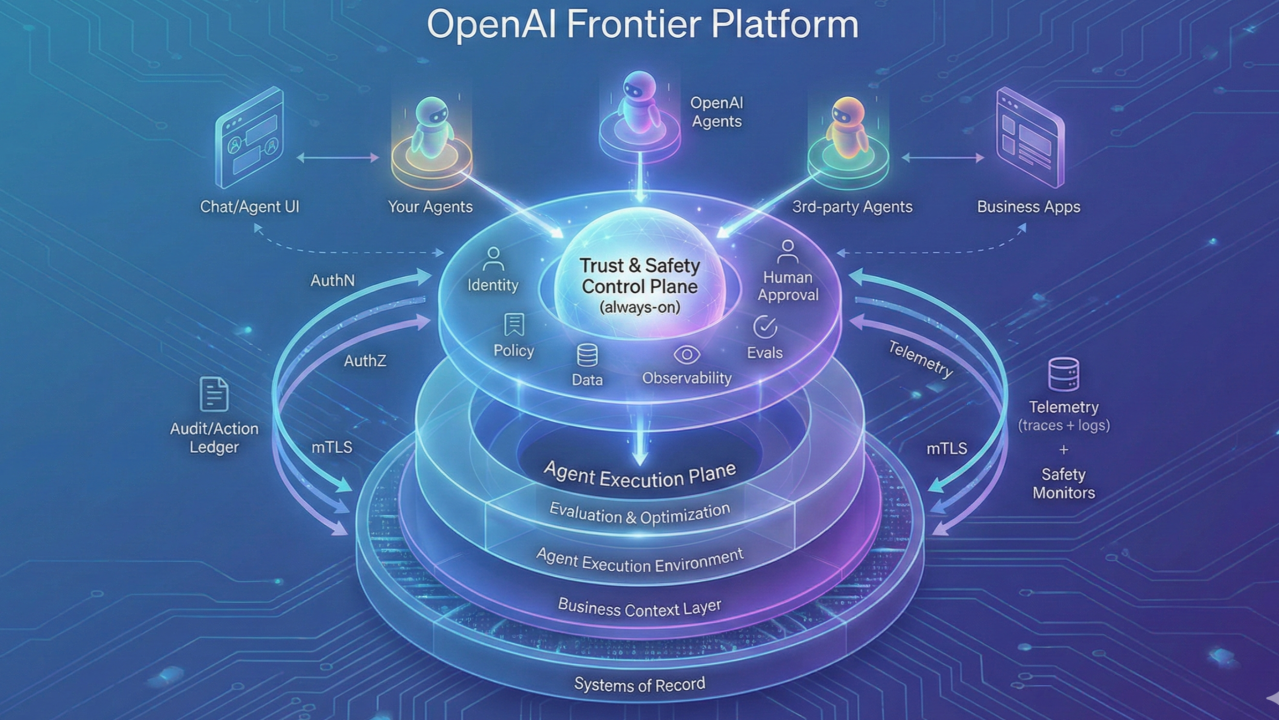
We are crossing the chasm from “AI that helps” to “AI that does.”
OpenAI’s recent Frontier announcement confirmed what many of us in enterprise infrastructure have suspected: The bottleneck isn’t model IQ anymore. It’s execution + trust.
Frontier isn’t just about smarter chatbots; it reads like a blueprint for operationalizing AI coworkers.
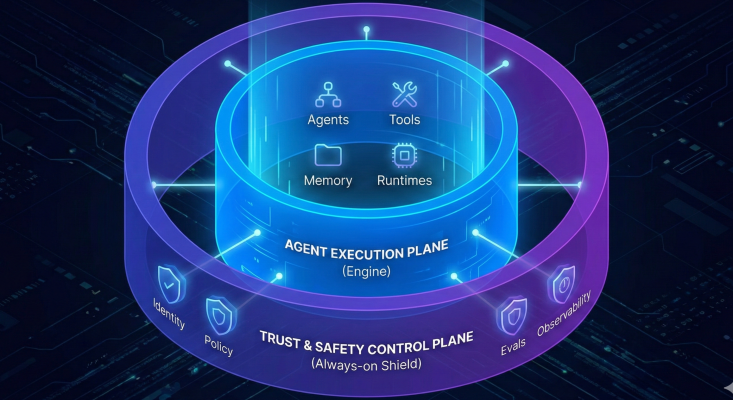
The “Frontier Stack”: Layered Defense
What Frontier Signals (Beyond the Headline)
The platform is positioned to build and deploy AI coworkers by giving them the “skills” we use to scale people: shared context, onboarding, feedback loops, and clear boundaries.
-
Shared Context is a First-Class Primitive: Agents aren’t trained on isolated docs; they connect to enterprise systems (CRM, ticketing, internal apps) to build a shared semantic understanding of the business.
-
From Conversation to Execution: The framing shifts from “AI answers questions” to “AI completes workflows”—coordinating multi-step tasks across tools, which is where both ROI and risk appear.
-
The Execution Environment Matters: Frontier highlights a dependable runtime (files, code, tools, memory), making it a controlled operating environment, not just an API call.
-
Identity & Permissions are the Scaling Lever: Agent systems need workload identity, least privilege, and auditability to be safe in real workflows.
The Reality Check
But here is the hard truth: If agents are the new runtime for work, security cannot be an afterthought. As we move from conversation to execution, the risk surface explodes.
We aren’t just worried about wrong answers anymore. We are worried about over-permissioned agents, authorized incidents, lateral movement through tools, and silent failures at scale.
If you are building agentic systems, you need a new architecture. You need Zero Trust for Agents.
Here is a practical blueprint for a trust fabric that allows agents to act autonomously without becoming an unbounded risk.
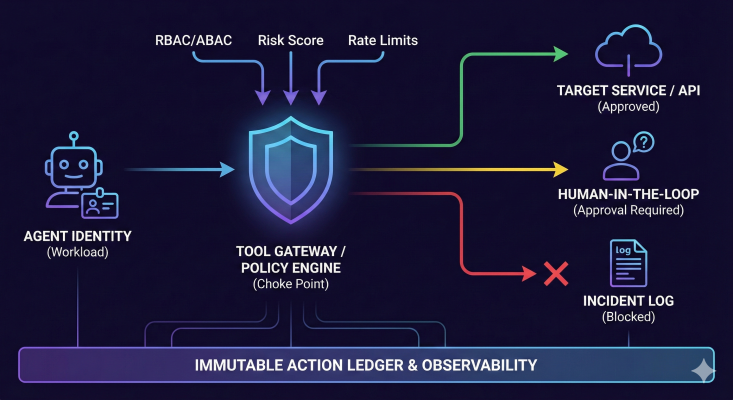
The 8-Point “Zero Trust Agent” Blueprint
1. Strong Agent Identity (Workload Identity) Treat agents like production microservices with unique, short-lived identities. Use mTLS with context claims for every call.
2. The Tool Gateway (Your New Perimeter) This is the most critical choke point. Nothing bypasses the gateway, which enforces allowlists, schema validation, and rate limits.
3. Policy-as-Code Authorization (Beyond the Prompt) Stop putting auth logic in natural language prompts. Move it to a deterministic policy engine that evaluates who, what, why, and real-time risk signals.
4. Governed Context Retrieval Shared context is vital but must not become data sprawl. Implement retrieval boundaries and DLP scanning on inputs and outputs.
5. Runtime Isolation & Egress Control Assume breach. Sandbox execution environments and ruthlessly restrict network egress.
6. The Immutable Action Ledger Observability is your safety net. Every agent decision must produce a trace ID and write to an append-only audit record.
7. Continuous Evaluation Loops Drift is inevitable. Constantly run offline eval suites for expected behavior and online scoring for safety and quality.
8. Step-Up for High-Risk Actions Design patterns for “human-in-the-loop” interrupt circuits when risk scores hit a threshold.
The Takeaway
The winners in this next phase won’t just be the ones with the smartest agents. It will be the teams that build the strongest trust fabric around those agents.
If you are building agentic systems today, I have one question for you:
Where is your policy enforcement living—inside the app logic, at a platform gateway, or scattered across a service mesh? Let me know in the comments. 👇
#AgenticAI #ZeroTrust #AIInfrastructure #PlatformEngineering #Cybersecurity #EnterpriseAI #MLOps