[writing]
WebMCP: The HTTP of the Agentic AI Age
WebMCP as the missing protocol layer for agents that browse and act on the web.
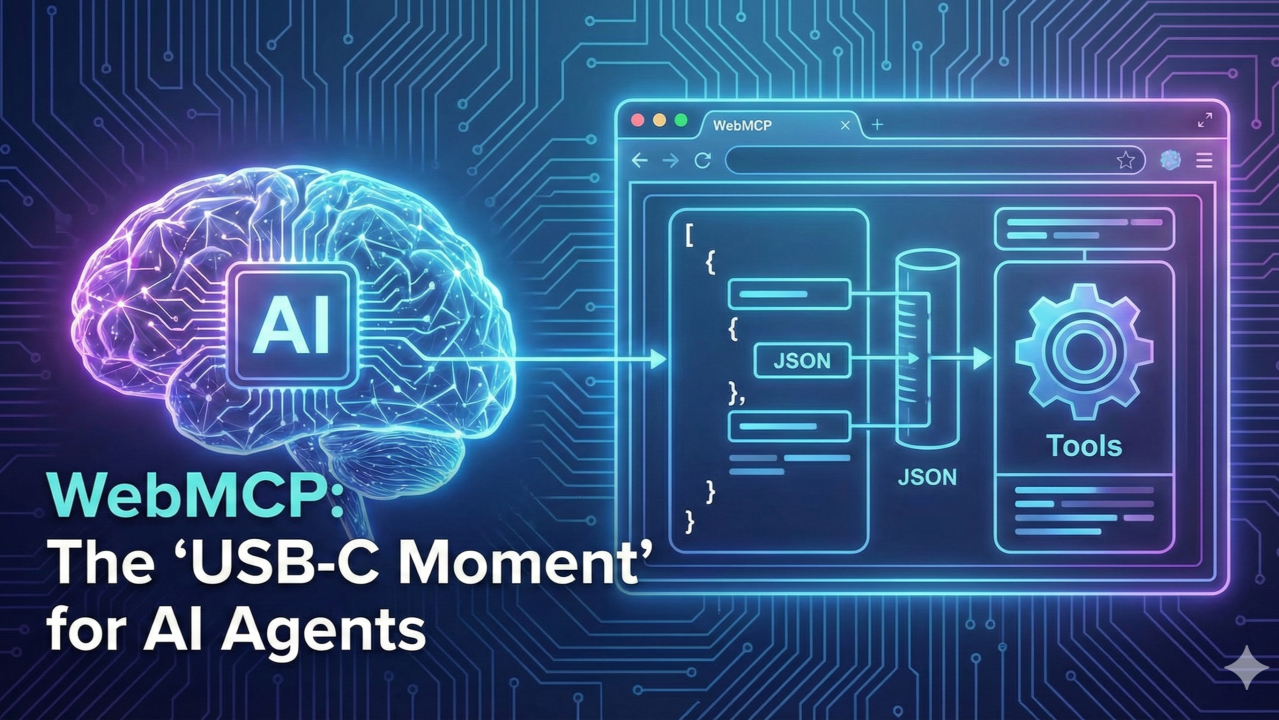
For the last three years, we’ve been forcing AI agents to browse the web like a human trying to read a book through a telescope.
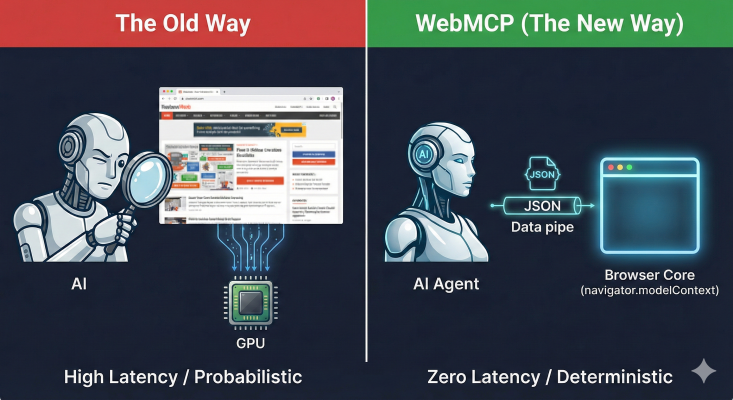
They render a page, take a massive screenshot, send millions of pixels to a vision model, and hope the AI guesses that the blue rectangle saying “Submit” is actually a button. It’s slow, expensive, and honestly, it’s fragile engineering.
This week, that era effectively ended.
With the release of Google’s Web Model Context Protocol (WebMCP) in Chrome 146, the web has fundamentally shifted. We are moving from a “visual-first” web, built for human retinas, to an “agentic-first” web built for AI reasoning. The browser is no longer just a document viewer; it is now a standardized API server that lets agents “talk” directly to websites.
If you are a CTO, Architect, or Engineering Lead, your roadmap just changed. Here is the deep technical breakdown of how WebMCP works, how to deploy it on Kubernetes with Zero Trust, and, most importantly, how to secure it when your “users” are no longer human
1. The Core Shift: The Browser as a Client-Side Server
To understand WebMCP, you have to flip your mental model of the web upside down.
In the traditional web, the browser is a client requesting data from a backend. In the WebMCP architecture, the browser tab becomes a server. It exposes a list of “tools” (capabilities) that a client (the AI agent) can call.
When an agent visits your site, instead of parsing DOM nodes or guessing CSS selectors, it performs a structured handshake:
-
Agent: “OPTIONS /capabilities” (Metaphorically)
-
Browser: “I can search_flights, add_baggage, and checkout.”
This eliminates the “Execution Gap.” The agent doesn’t need to calculate X/Y coordinates for a simulated click; it simply invokes a function.
2. Two Roads to Integration: Declarative vs. Imperative
WebMCP gives us two distinct interfaces to expose these capabilities. One is for the HTML purists (SEO-style), and the other is for the JavaScript power users (Application-style).
The Declarative API: “Agent Optimization” (AO)
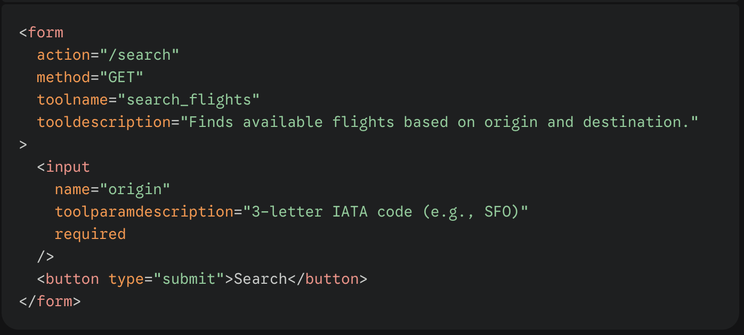
If you have a legacy application or a Server-Side Rendered (SSR) site, you don’t need a rewrite. You just need to annotate your existing HTML forms. Think of this as Agent Optimization (AO), the new SEO.
The Code: You add toolname and tooldescription attributes. The browser automatically synthesizes these into a JSON schema for the agent.
The Imperative API: Full Programmatic Control
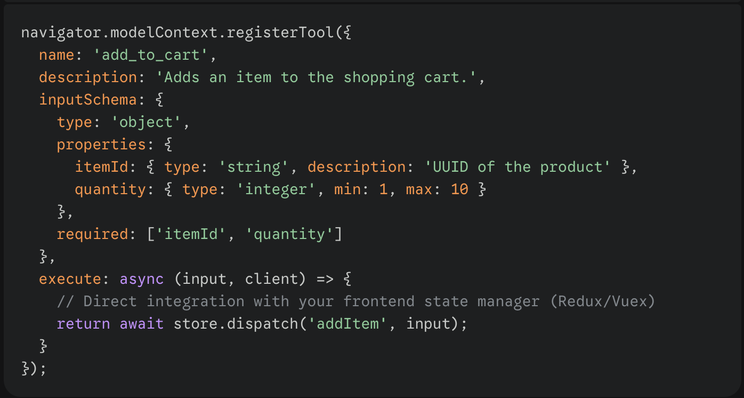
For Single Page Applications (SPAs) or complex state changes (like a “Crop Image” feature), HTML forms aren’t enough. You need the Imperative API, which lives on the navigator.modelContext object.
3. Zero Trust Security: Inverting the Perimeter
Deploying WebMCP in an enterprise environment introduces a terrifying variable: The user might be an autonomous agent.
Traditional security relies on “Ingress Control” (stopping bad guys from getting in). Agentic security requires Egress Control (stopping your own agents from sending data out to the wrong place).
The “Lethal Trifecta”
Security researchers define the “Lethal Trifecta” for agents as the combination of:
-
Access to Private Data (e.g., reading emails).
-
Access to Untrusted Content (e.g., reading a webpage).
-
External Communication (e.g., sending an API request).
If an agent has all three, a malicious website can use “Prompt Injection” (hidden text on a page) to trick your agent into exfiltrating secrets
Mitigation: The Reference Pattern
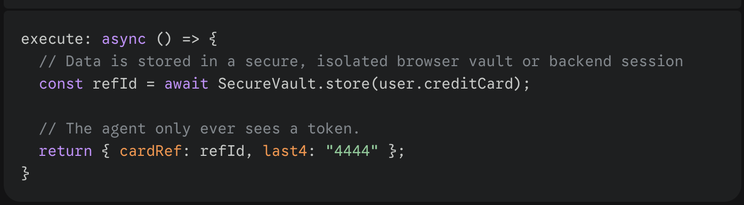
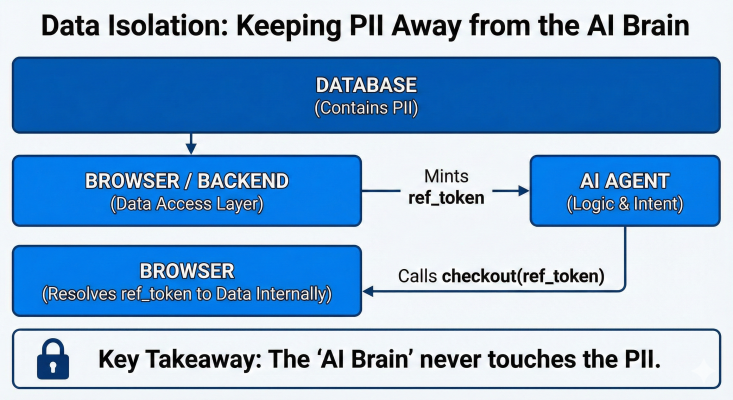
WebMCP solves this by enforcing a Reference Pattern. The rule is simple: Never give the LLM the raw sensitive data. Give it a token instead.
❌** INSECURE:**

✅** SECURE (WebMCP Reference Pattern):**
4. Enterprise Architecture: Kubernetes, Service Mesh & Edge
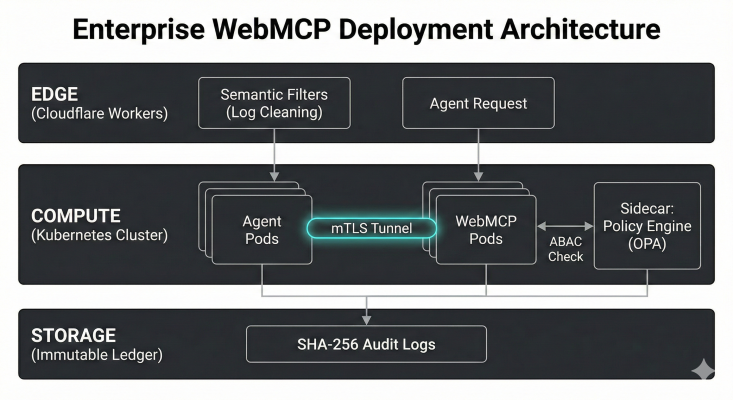
How do you deploy this at scale? You don’t just run it on a laptop. You deploy MCP Servers as microservices within your existing infrastructure.
The “Agent Mesh” (Istio Ambient Mode)
In a Kubernetes cluster, you treat Agents and Tools as distinct workloads.
-
Identity Sprawl: Every agent instance needs a SPIFFE ID. You must audit exactly which agent instance (e.g., spiffe://cluster.local/ns/agents/sa/finance-bot-v2) accessed a resource.
-
mTLS: Use Istio Ambient Mode (sidecar-less) to enforce mutual TLS between the Agent Pod and the MCP Server Pod. This ensures that even if the cluster is breached, an attacker cannot spoof an agent’s identity.
Authorization: Why RBAC Fails & The Need for ABAC
In a traditional app, Role-Based Access Control (RBAC) works: “User is an Admin, so they can Delete.”
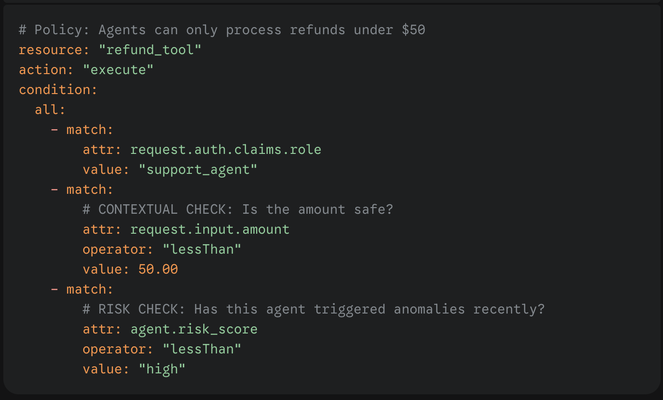
For agents, RBAC is dangerous. An agent might be “acting as an Admin,” but it shouldn’t have carte blanche to delete the database because it hallucinated a command. You need Attribute-Based Access Control (ABAC) to evaluate the context of the request.
The Policy Check (Open Policy Agent / Cerbos style):
Immutable Auditing: The “PhysicalTask” Protocol
For regulated industries (Finance, Healthcare), “The AI did it” is not a valid legal defense. We are seeing the adoption of Cryptographic Intent Logging.
-
Every time an agent constructs a tool call, the infrastructure generates a SHA-256 hash of the prompt (intent) and the payload (action).
-
This hash is written to an immutable ledger. If an agent goes rogue, the SOC can replay the cryptographic chain to prove exactly why the agent made that decision.
5. Strategic Takeaway: The “Dual-Layer” Web
We are witnessing the bifurcation of the internet.
-
Layer 1 (Visual): Built with CSS, Canvas, and React for human eyes.
-
Layer 2 (Agentic): Built with WebMCP, JSON Schema, and Policy-as-Code for AI minds.
If you are a technical leader, “Agent Optimization” is the new battleground. Deploying WebMCP endpoints isn’t enough; you must secure them with Zero Trust principles, govern them with ABAC policies, and optimize them at the Edge.
The bots are coming to your website. Make sure you speak their language.
What are your thoughts on the security implications of client-side agent servers? Let’s discuss in the comments. 👇